
Architecture
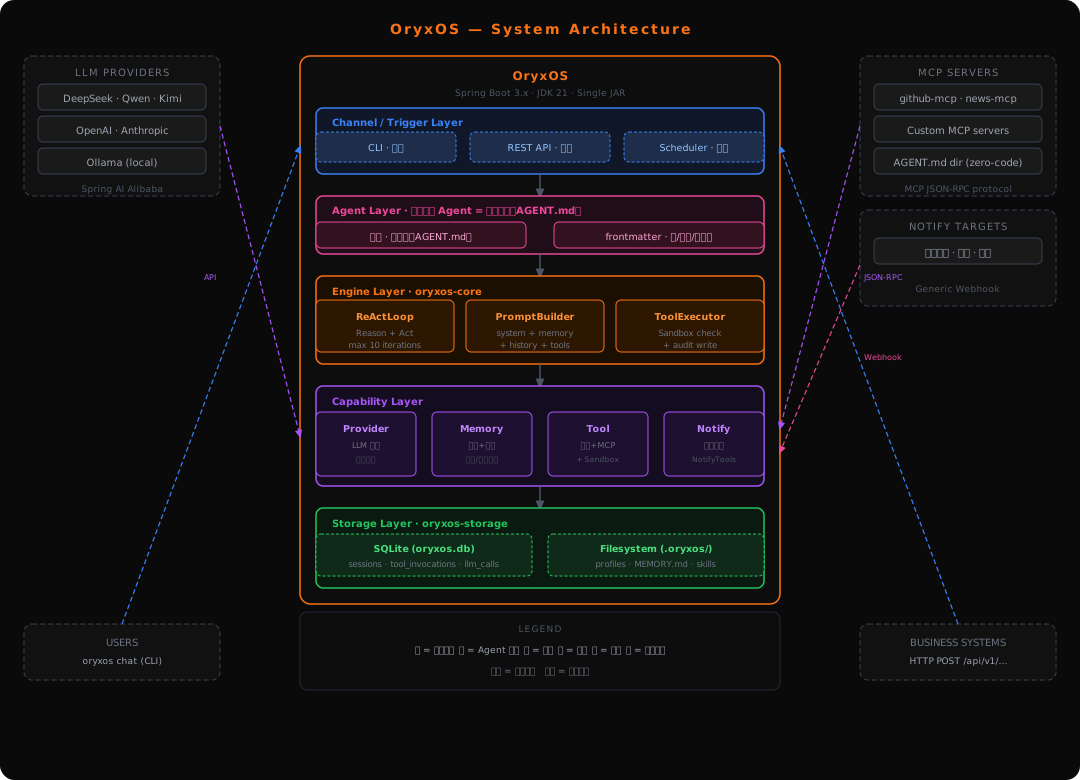
OryxOS is a Spring Boot 3.x single-binary application running on JDK 21. The entire system — LLM routing, reasoning loop, memory, tools, REST API, and the web admin console — ships as one fat JAR. No external dependencies are required beyond a JVM and the LLM provider credentials you configure. State is stored in SQLite and on the local filesystem under the workspace directory (.oryxos/ by default, configurable — see below).
The reasoning engine is a self-implemented ReAct loop. Spring AI's OpenAI connector handles OpenAI-compatible LLM protocol translation; OryxOS owns the loop, the context assembly, the tool dispatch, and the audit records.
Architecture Diagram
Layer Diagram
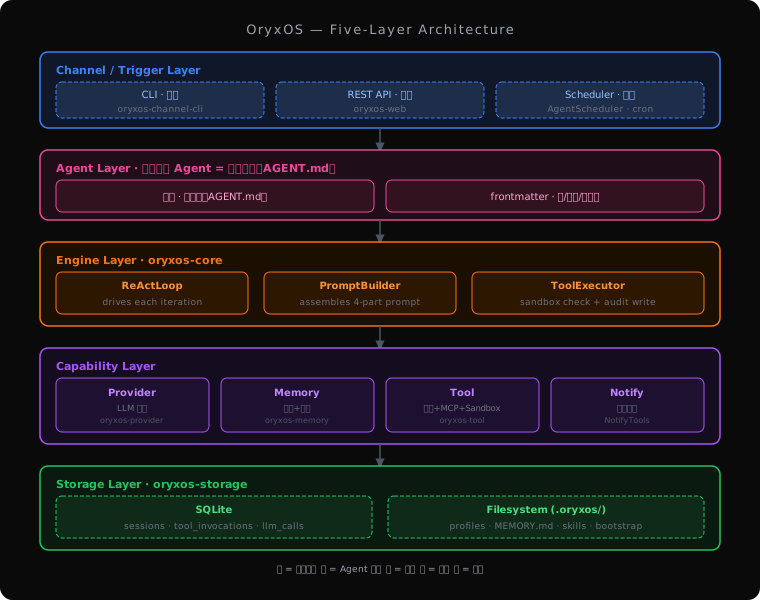
Channel Layer — the entry points. CLI handles interactive use and local debugging. The REST API handles business system integration and backs the web admin console. Both funnel into the same engine.
Engine Layer — the Agent brain. ReActLoop drives each iteration: assemble prompt, call LLM, inspect response, execute tools, append results, repeat. PromptBuilder assembles the four-part prompt on each iteration. ToolExecutor dispatches tool calls, enforces sandbox policy, and writes audit records.
Capability Layer — what the engine calls out to. ProviderService routes LLM calls to the configured provider, resolved dynamically by name from the provider registry. MemoryService provides conversation history and long-term memory. ToolRegistry holds all registered tools, built-in and MCP-backed alike.
Storage Layer — persistence. SQLite stores sessions, tool-invocation and LLM-call audit records, scheduled tasks and their execution history, per-agent memory entries, notify channels, and provider definitions. The filesystem stores agent directories (AGENT.md plus optional skills/, scripts/, REFERENCE.md), Bootstrap files, and MEMORY.md — anything a user might want to edit directly or track in git.
One Directory = One Agent
Every Agent is a single directory: .oryxos/agents/<name>/. There is no separate .oryxos/profiles/ — the Profile is the agent.
AGENT.md= YAML frontmatter (the Agent's Profile:name,description,identity,provider/model,tools,mcp_servers,channels,bootstrap,settings,schedules) + a body of task instructions injected into the system prompt.AgentLoader.deriveProfile(agentDir)turns the frontmatter into theProfilethe runtime understands.- Optional
skills/*.mdsub-instructions,scripts/, andREFERENCE.mdsit in the same directory and are loaded on demand through the ordinaryread_file/shelltools — no global skill index, nouse_skill. - Long-term memory is per-agent:
.oryxos/agents/<name>/MEMORY.md(falling back to the global.oryxos/memory/MEMORY.mdwhen there is no agent context). Memory lines are timestamped, and every trigger of an agent is auto-recorded to that agent's archival memory.
Dynamic Agent Lifecycle
Agents can be created, updated, and removed at runtime — no restart required.
- CRUD via REST —
POST /api/v1/agentswrites.oryxos/agents/<name>/AGENT.md, derives the Profile, and registers the agent (rolling back on failure);PUTupdates it (a schedule change unregisters then re-registers);DELETEperforms a soft delete: unschedule → remove from registry → archive the directory (never a physical delete). - Drop-in via WorkspaceWatcher — a JDK
WatchService-based watcher observes.oryxos/agents/. Dropping a directory in makes the agent live immediately; the same watcher keeps the registry in sync with on-disk edits. - One-sentence generation —
POST /api/v1/agents/{name}/generate-filesturns a single sentence into a draftAGENT.mdvia the LLM. The draft is preview only — it is neither saved nor registered until the user confirms and saves it (POST /api/v1/agents/{name}/files).
Dynamic Provider & Notify-Channel Registries
Providers and notify channels are no longer static config — both are stored in SQLite and managed through CRUD endpoints.
- Providers (
providerstable) —ProviderApiControllerexposes create/list/get/update/delete. At runtime the engine resolves theChatModeldynamically by provider name; models are built and cached by(name | apiKey | baseUrl), so editing a key or base URL rebuilds the model on the next call. Theoryxos.providers[]config is seeded into the table on first startup, after which the database is authoritative. Constitution principle III (an explicitprovider name → ChatModelmap) is preserved — the map is simply runtime-mutable. Themockprovider is a built-in fake model needing no key or URL. - Notify channels (
notify_channelstable) —NotifyChannelApiControllerexposes the same CRUD. A channel has atype(feishu|wecom|dingtalk|webhook) and a URL. Thenotifytool references a channel by name (in theAGENT.mdbody, e.g. "notify team-lark"); the tool resolves the registered channel to its adapter and URL. There is nonotify_channelsfield in the frontmatter.
Configurable Workspace Root
The workspace directory defaults to .oryxos but is configurable:
oryxos.rootinapplication.yml— affects the Spring-booted commands (serve/gateway).ORYXOS_ROOTenv var or-Doryxos.root=— affects the zero-Spring light CLI commands (init/status/profile) and, through Spring relaxed binding, the booted commands too.
The configured root is auto-added to the file sandbox whitelist at runtime, so changing the root never breaks the file tools.
REST API Surface
All endpoints live under /api/v1, speak JSON, and (in the core phase, on the assumption of an internal network) require no authentication. Every response is wrapped in a unified envelope:
{ "code": 0, "message": "success", "data": {}, "timestamp": 1720000000000 }code 0 means success; errors carry a non-zero code and message (400 for bad input, 404 for a missing resource). Ten controllers make up the surface:
| Controller | Responsibility |
|---|---|
SystemApiController | GET /health, GET /info (runtime info + configured providers) |
AgentApiController | Agent CRUD, invoke, per-agent memory / session, generate-files, files |
ProviderApiController | Provider CRUD (SQLite-backed) |
NotifyChannelApiController | Notify-channel CRUD (SQLite-backed) |
SessionApiController | Session create / list / get / archive; messages runs the ReAct loop synchronously |
ScheduleApiController | List schedules, execution history, run-now, enable/disable |
ProfileApiController | List derived profiles (one per agent directory) |
ToolApiController | List registered tools (built-in + MCP) |
SandboxWhitelistController | Runtime-manage the FILE / SHELL / HTTP whitelists |
WorkspaceApiController | Read-only workspace tree; read/write a file with path-traversal guard |
Web Admin Console
A Vue 3 + Vite single-page app is served at /admin/, styled to match the marketing website. The sidebar groups: 概览 (Overview) / Agent 列表 / 定时任务 (Schedules) / Skill 列表 (placeholder) / 知识库 (Knowledge Base) (placeholder) / and an OS Runtime group holding 会话列表 (Sessions), Provider 列表, Tool 列表, Notify 渠道, and SandBox 列表.
- The Agent list shows a description column and per-row 立即触发 (trigger now, via a console session), 详情 (detail), and 删除 (delete) actions; the detail view has tabs for basic info / generate / files / session / memory, including the one-sentence "generate" flow (preview then save). The memory tab shows two tables — 核心记忆 (core) and 归档记忆 (archival).
- The Provider and Notify-channel pages offer full CRUD; provider api-keys are shown in plaintext by design.
- Add/edit forms are modal dialogs, and every list has a refresh button. The workspace file browser exposes the on-disk agent tree.
Module Structure
| Module | Responsibility |
|---|---|
oryxos-core | Core abstractions and interfaces: OryxTool, Session, Profile, ContextLoader, ReActLoop, PromptBuilder, ToolExecutor, AgentService, AgentLoader |
oryxos-provider | LLM routing: ProviderService, Function Calling format adaptation, dynamic provider name → ChatModel resolution backed by the provider registry |
oryxos-memory | Memory: MemoryService facade, LongTermMemory (reads/writes per-agent MEMORY.md), MemoryTools (save_memory, recall_memory) |
oryxos-tool | Tool system: built-in tools (FileTools, ShellTools, HttpTools, NotifyTools), McpClientService, McpToolAdapter, ToolRegistry, SandboxChecker |
oryxos-channel-cli | CLI channel: CliChannel, oryxos chat command implementation |
oryxos-web | REST API: ten ApiController classes, GlobalExceptionHandler, the unified response envelope, OpenAPI spec, and the Vue admin console served at /admin/ |
oryxos-storage | Persistence: SQLite via Spring Data JPA — session, tool-invocation, LLM-call, scheduled-task, task-execution, memory-entry, notify-channel, and provider repositories |
oryxos-cli | CLI entry point: Picocli main, 12 subcommands, ConfigLoader for credentials and config validation |
oryxos-boot | Spring Boot bootstrap: main class, auto-configuration, dependency aggregation |
Modules communicate through interfaces. Adding a new Channel or Tool implementation means adding a new module — oryxos-core is not touched.
Key Technical Decisions
| # | Decision | Choice | Reason |
|---|---|---|---|
| 1 | ReAct loop implementation | Self-implemented; does not use Spring AI's Agent abstractions | Full control over loop behavior; no hidden tool double-execution |
| 2 | Spring AI usage boundary | Protocol translation and @Tool JSON Schema generation only; automatic tool execution explicitly disabled | Spring AI's auto-execution would run tools twice — once by Spring AI, once by ToolExecutor |
| 3 | Execution model | Synchronous blocking with Java 21 virtual threads | Straightforward code, high concurrency without reactive programming complexity |
| 4 | Provider resolution | Dynamic provider name → ChatModel map backed by a SQLite registry, cached by (name|apiKey|baseUrl) | Explicit mapping (never Bean-type scanning) but runtime-mutable, so providers can be added or edited without a restart |
| 5 | HTTP service layer | Spring MVC + Java 21 virtual threads | Sync-style code, thousands of concurrent requests per node; SseEmitter available for streaming in extension phase |
| 6 | Sandbox strategy | Path/pattern whitelists at the application layer, runtime-manageable | SecurityManager is deprecated since JDK 17 and unavailable on JDK 21; full container-level sandbox is extension-phase work |
| 7 | Persistence | SQLite + Spring Data JPA for relational data; per-agent MEMORY.md for long-term memory | Single binary, no external database process required; audit tables written from day one so auditability is never retrofitted |
Tech Stack
| Component | Choice |
|---|---|
| Language / runtime | Java 21 (required; virtual threads, no SecurityManager) |
| Framework | Spring Boot 3.x |
| LLM integration | Spring AI (OpenAI-compatible protocol translation and @Tool schema generation only) |
| HTTP service | Spring MVC with Java 21 virtual threads |
| Admin console | Vue 3 + Vite (served at /admin/) |
| CLI | Picocli |
| YAML parsing | SnakeYAML |
| Persistence | SQLite + Spring Data JPA (schema.sql maintained by hand; CREATE TABLE IF NOT EXISTS, no fragile SQLite ALTER) |
| Long-term memory | per-agent MEMORY.md flat file, keyword search; vector retrieval planned for extension phase |
| MCP integration | MCP Java SDK (MCP Client for connecting to external MCP servers) |
| Logging | Logback + SLF4J, structured JSON output |
| Build | Maven multi-module |
| Future: native binary | GraalVM Native Image (extension phase, reduces startup from ~3s to <100ms) |
| Future: observability | Micrometer + Prometheus (extension phase) |