
Why OryxOS
Agents shouldn't belong only to big tech
Every company has work an agent should be doing right now: the daily report someone compiles by hand, the alert that needs triaging at 3am, the PR digest, the customer question answered for the hundredth time. The models are ready. Yet in most companies, agents are still demos.
Why? Four barriers, none of which is the model:
Defining an agent requires engineers. Today's mainstream path is code — a framework, a runtime, glue logic, a deployment. The people who best understand the work (ops, support, HR, finance) can describe it perfectly in one sentence, and can't ship an agent at all.
The data has to leave. Cloud agent platforms solve infrastructure by taking your data with it. For any company with data-residency, network-perimeter, or audit obligations, that's a non-starter.
It's a black box. An agent that can run shell commands, write files, and call external APIs — with no record of what it did, no whitelist on what it can do, and no one approving the dangerous steps — is not something an enterprise can put into production.
One agent is easy. A fleet is not. A single wrapped LLM loop is a script. Running dozens of agents — with shared providers, shared tools, schedules, lifecycle, and governance — is an operating-systems problem, and almost nobody hands you that layer.
Our answer
OryxOS removes all four barriers at once:
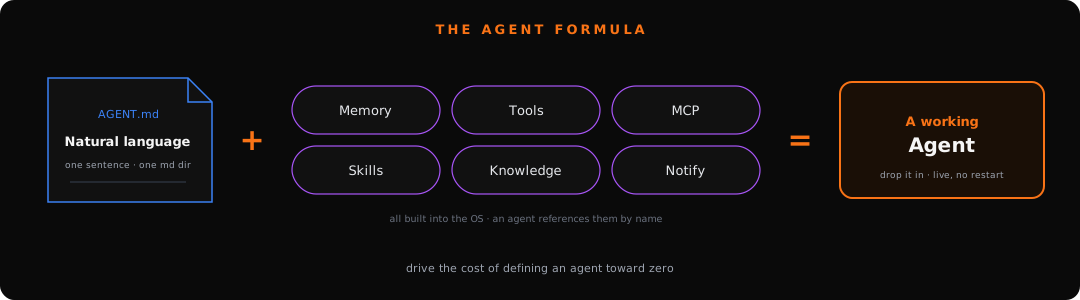
- Plain language instead of code. One sentence — or one markdown directory — defines an agent. The OS supplies everything else: memory, 24 built-in tools, MCP connectors, skills, notifications, scheduling. The cost of defining an agent trends toward zero.
- Your infrastructure, your data. One self-hosted binary on your own servers or K8s. No managed service, no telemetry, no cloud lock-in.
- Glass box, not black box. Every tool call and every LLM call is persisted to the audit tables from day one — what was invoked, with what arguments, what came back, how long it took. Sandbox whitelists gate files, shell, and HTTP. Governance is the foundation, not a bolt-on.
- An OS for the fleet. Agents are processes; OryxOS is the operating system — lifecycle, routing, shared registries, scheduling, console, and API for all of them at once.
So every company can run its own agents — in plain language.
Why a team of agents, not one super-agent
Real work is rarely one skill. "Research the market, draft the report, have someone check the numbers, send it to the team" is a team's job — decompose, parallelize, review, deliver. That's why our north star is not a smarter single agent but this:
You publish a task in one sentence → OryxOS decomposes it → assembles a team of agents → they collaborate → the result is delivered.
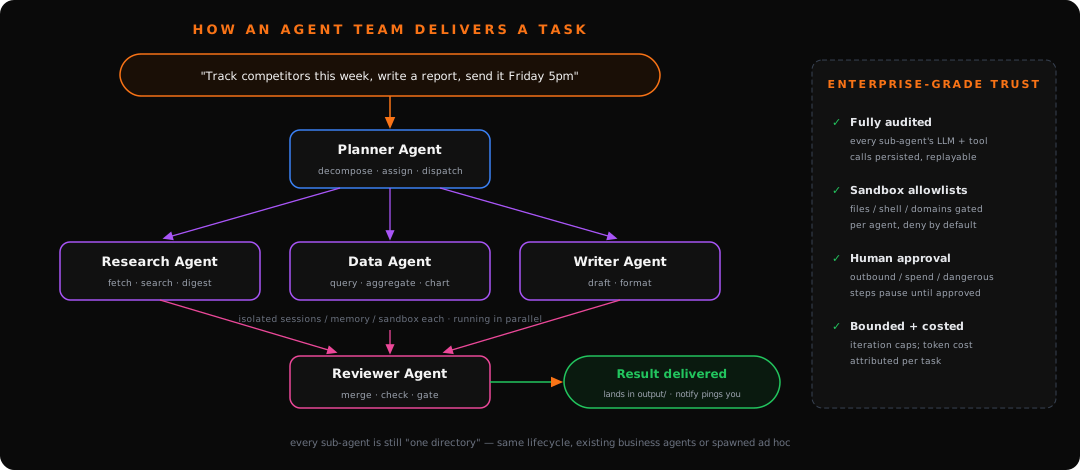
The industry has proven the pattern works (planner–worker–reviewer crews, agent-to-agent protocols). What's missing is the version an enterprise can actually trust: every sub-agent auditable, every dangerous action gated by human approval, cost attributed per task, iterations bounded. That trustworthy version is precisely what an Agent OS — and only an OS layer — can provide. See the Roadmap.
Why an OS, not another framework
The common assumption is that better agents need better models. In production, the bottleneck is the harness — the scaffolding between the model and the real world: the right context assembled before every call, tools that are whitelisted rather than open-ended, execution that is isolated and audited, and messages that reliably reach their destination.
A framework gives you one harness inside your own code. OryxOS ships the harness as infrastructure and runs a fleet on top of it — which is what changes who can use it: with a framework, engineers build agents; with an OS, anyone who can describe the work runs agents.
What OryxOS is not
Not a cloud platform. No managed offering, no telemetry collection, no dependency on any external cloud service. It's a binary on your infrastructure.
Not a single-agent tool. A tool that wraps one LLM call in a loop is a script — one harness, hard-coded. OryxOS hands a reusable harness to a whole fleet: many agents, one directory each, created and managed at runtime, shared capabilities across all of them.
Not another framework port. OryxOS makes its own architectural bets: a self-implemented, fully inspectable ReAct loop instead of a framework-managed one; synchronous execution on virtual threads instead of async/reactive; explicit provider routing instead of auto-wiring; durable persistence over in-memory state.
Not production-complete on day one. What's shipped is the runtime kernel — the five core capabilities, working and tested. Multi-tenancy, SSO, role-based tool policy, container-grade isolation, and the multi-agent team are roadmap work, and the docs are explicit about that boundary.
Why now
AI programming changed the economics. A small, focused team can now build and maintain what used to take an engineering organization — and OryxOS itself is built that way, with AI, by contributors who own the result.
Open standards just matured. MCP has become the de facto standard for tool interoperability; A2A is emerging for cross-agent coordination. OryxOS builds on both from the start, so what plugs into OryxOS works in the broader ecosystem and vice versa.
The alternative is worse. Without a purpose-built agent OS, teams bolt together controllers, hand-rolled prompt assembly, home-grown tool dispatch, log-only audit, and no shared memory. It works until it doesn't — and debugging it in production is archaeology. A runtime with clear contracts, persistent audit, and a defined extension model is the better foundation.